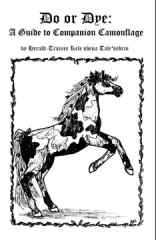
A Handbook Written By Elizabeth Barrette
Illustrated By Angela K. Scott
Digest sized (5.5"x8.5"), 20 pages, staple bound, cardstock covers
At any time, a Herald might find him or herself in a situation where it just isn't safe to be a Herald. In this handy, digest sized guide, Herald-Trainee Kele shena Tale'sedrin takes a look at a wide variety of dyes and disguises which can be used to get you and your Companion safely out of dangerous situations (or, if you're spying, into them).
Just the right size to slip into a saddlebag or tuck into a boot top, Do or Dye covers subjects such as:
Acting like a horse
Use of horse tack
Ways to disguise those distinctive blue eyes (such as blinders)
Scent-masks
Types of dyes (with their advantages and disadvantages)
This is the perfect reference for any Herald on a dangerous field assignment...or read the entries on "Manure, fresh" and "Tar" for a good laugh!
From the introduction:
When you're in the field, no matter what you're doing, the most conspicuous thing is your Companion. This can be good or bad. It's good when someone needs to find you in a hurry. It's bad when someone's trying to turn you into crowbait. That huge white shape is an irresistible target. Now, you can easily shuck your uniform and dress like a peasant if you have to, but your Companion can't do that. And, unfortunately, Companions don't take dye very well, as any darkening agent fades rapidly. What lasts for months on horses won't last two weeks on a Companion. However, there are some short-term solutions and quickie-fixes that can keep you from getting killed. If nothing else, note the duration of your chosen dye and reapply as necessary.
There are two primary reasons to use a color-mask. The first is to make your Companion look like a normal horse, in which case it doesn't matter what color you use or whether you leave any white showing. The second is to prevent light areas from making you a target, in which case you need the darkest all-over color you can get. It goes without saying that if you are using an all-over black to keep from showing up pale, you will have to black your clothes and tack as well. Always wash your Companion after every dye job, even if it was only partial and even if the color wears off on its own. It is important to remove the residue anyway.
Availability, application, duration, removal, advantages, and disadvantages are given for all dyestuffs. In addition, I have added several other items of disguise which, although not actual dyes, can definitely color the perceptions of your enemies-in other words, they'll think you're with a horse. All entries are listed alphabetically.